








Nguyen Vu Ky, Division of Agriculture System, WASI.
Email: vuky124@gmail.com
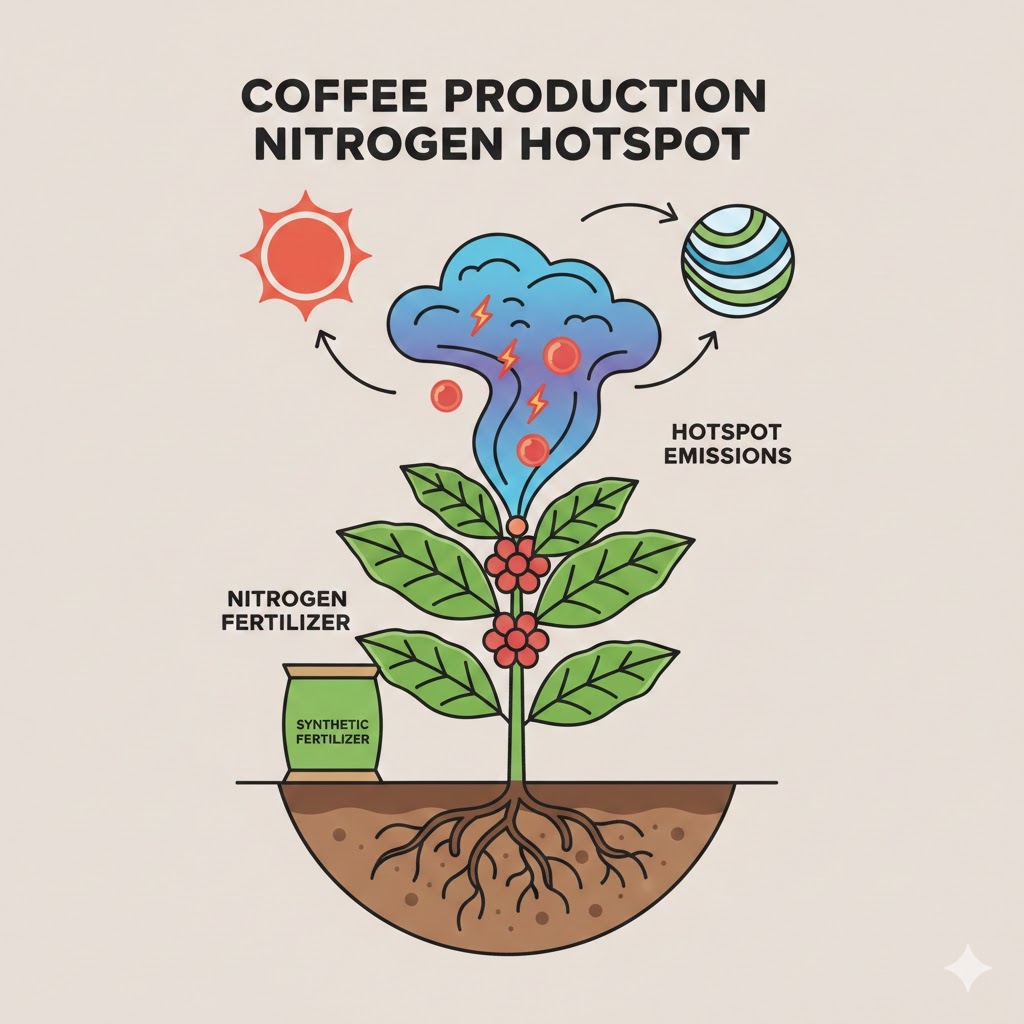
Our study results on greenhouse gas (GHG) emissions from intercropping systems in Robusta coffee farms in Dak Lak province showed that synthetic fertilizer played the role of the absolute dominant driver of GHG emissions, specifically acting as the central “emission hotspot” that overshadows all other farm inputs.
- The Dominant Source of Emissions: Synthetic nitrogen fertilizer was identified as the single largest contributor to the carbon footprint of coffee farming. Across all farm types surveyed, the use of inorganic fertilizers accounted for approximately 71% of total emissions. When analyzed specifically within intercropping systems, this figure ranged between 75.8% and 81.8% of total emissions, rendering all other sources, such as irrigation, lime, and fossil fuels, minor in comparison[1].
To contextualize its dominance, emissions from synthetic nitrogen fertilizer (2,300 to 4,340 kg CO₂e/ha) were significantly higher than those from urea, phosphorus, and potassium fertilizers. It also outweighed emissions from irrigation (~8%), lime (~6%), and plant protection products (~4.8%)
- The Mechanism of Emissions: The “hotspot” status of synthetic nitrogen is driven by the biological and chemical processes that convert applied nitrogen into nitrous oxide (N2O), a gas with a Global Warming Potential 273 times that of CO2[2]. Of which:
Direct Emissions: When synthetic nitrogen fertilizers are added to the soil, they increase the available nitrogen for microbial processes. This enhances nitrification of the oxidation of ammonium to nitrate) and denitrification (the reduction of nitrate to nitrogen gas), both of which are released directly as by-products from the soil[3].
Indirect Emissions: Synthetic nitrogen also drives emissions off-site through two pathways:
- Volatilization: a fraction of the applied nitrogen vaporizes as ammonia (NH3) and nitrogen oxides (NOx), which deposit elsewhere and convert to N2O.
- Leaching and Runoff: Nitrogen that is not taken up by plants (mainly as nitrate NO3-) leaches into groundwater or runs off into surface waters, where it undergoes transformation into rivers and estuaries. The default factor for the fraction of nitrogen lost to leaching in wet climates is 0.24 (24% of applied N)
- Drivers of High Emissions: the role of nitrogen as a hotspot is exacerbated by specific farming behaviors and environmental factors.
Overuse: farmers in the Central Highlands frequently apply significantly more nitrogen than recommended, up to 300% more in some cases, believing that high inputs guarantee high outputs.
Intercropping Demands: The integration of high-value crops like durian and black pepper has led farmers to increase agrochemical inputs further. Systems including durian were noted as the most input-intensive, often disregarding the actual nutrient demands of the mixed crops in favor of maximizing yield.
Habit over Science: The application of fertilizers is often driven by habit rather than scientific assessment of soil or crop needs.
- Comparison with other activities: Understanding the scale of the nitrogen “hotspot,” it is helpful to compare it to other farming activities:
Nitrogen Fertilizer: ~71% of total emissions.
Irrigation (Energy use): ~8% (the second-largest source).
Lime: ~6%.
Pesticides/Plant Protection: ~4.8%.
- Implications for Mitigation: Because synthetic nitrogen is the primary hotspot, it also represents the greatest opportunity for decarbonization. The study concludes that reducing inorganic fertilizer use and substituting it with organic alternatives (such as animal manure or compost) is the most impactful strategy for lowering the carbon footprint of these farms. Systems that relied less on intensive fertilization, such as coffee intercropped with avocado, demonstrated significantly lower overall emissions
[1] N. V. Ky (2025). Assessment of Greenhouse Gas Emissions from the Intercropping Systems in Robusta Coffee Farms in Dak Lak, Vietnam. Graduate School of Science and Technology, University of Tsukuba
[2] IPCC (2021). Climate Change 2021 – The Physical Science Basis. Contribution of Working Group I to the Sixth Assessment Report of the Intergovernmental Panel on Climate Change. Cambridge University Press. https://doi.org/10.1017/9781009157896
[3] IPCC (2019). 2019 Refinement to the 2006 IPCC Guidelines for National Greenhouse Gas Inventories. https://www.ipcc-nggip.iges.or.jp/public/2019rf/vol4.html.